
Is your RTPB delivering on its promise?

Concerns about prescription abandonment due to increasing costs and complications caused by the prior authorization (PA) process have led many health systems to adopt a tool to help with patient treatment decisions called real-time prescription benefit (RTPB).
When integrated with an organization’s electronic health record (EHR) system, RTPB delivers patient-specific cost and benefit transparency, including PA requirements, at the point of prescribing. The technology gives the provider insight into pharmacy benefit plan coverage, which can be used to eliminate patient surprises at the pharmacy because of the cost of a medication or a delay for a PA approval.
The problem, some health systems report to Cencora Benefit eServices, is that their RTPB network is not providing prescription cost and coverage information for many patients — or there is an issue with the quality of the information that is provided. For them, the once promising technology is now another tool providers ignore.
So how can health systems with an RTPB network in place — or who are considering implementing RTPB for the first time — ensure it performs as advertised? How can organizations significantly reduce inconsistent RTPB results and take advantage of RTPB’s value for patients, providers, and health systems?
This report provides a closer look at the value of RTPB, two primary reasons for the data gaps that cause RTPB networks to not perform as expected, and expert advice on how health systems can begin to address their RTPB data gaps.
Patient experience and outcomes
Provider use of RTPB increased by over 75 percent1 between 2019 and 2020. Health systems have embraced RTPB because patient cost and coverage transparency at the point of care can help improve patient outcomes and experience.
For many patients, cost is a top concern2 every time they consider a recommended prescription treatment. Cost for a treatment may cause a patient to abandon a treatment that has been started, or may prevent a patient from starting a prescribed treatment in the first place. According to a 2020 report from the IQVIA Institute ,3 patients abandon scripts approximately 30 percent of the time when the out-ofpocket cost is at or above $50. The abandonment rate increases as the out-ofpocket cost increases. Abandonment due to cost can especially be an issue for specialty medications, which have an average out-of-pocket cost of over $200 and account for 49.5 percent of the U.S. prescription drug spend .4
Patient medication access is further complicated by the PA process. Often, a patient does not learn that the medication the provider ordered requires a PA approval until arriving at the pharmacy. Only then, the pharmacist initiates the PA process for the medication and the patient is told to return days later, often leading to delayed or abandoned treatment. According to the 2020 AMA Prior Authorization Physician Survey,5 94 percent of providers report that access to care was delayed for patients whose treatment required a PA. Furthermore, 79 percent of providers report that a PA can “at least sometimes” lead to treatment abandonment.
With an EHR-integrated RTPB solution in place, a provider can conveniently review the patient’s costs and benefits information during the appointment. Matt Schaefer, President of Cencora Benefit eServices, explains, “RTPB empowers the provider and the patient with data, allowing them to have a more meaningful conversation before the patient goes to a pharmacy.”
The provider and patient can review the cost and benefit information for proposed prescription treatments to decide on a treatment plan the patient can access.
Jason Reed, a licensed pharmacist and Director of Product Development at Cencora Benefit eServices, adds how the perception of medication affordability can be an important factor in medication nonadherence. He cites a recent CDC study 6 that suggests when patients perceive that a medication is affordable, they are more likely to follow through on a therapy. Reed asks, “Wouldn’t it be best for everyone if the cost of the therapy the doctor and patient decide on is understood up front?”
Furthermore, RTPB lets a provider know if a PA is required for the medication being considered. Knowing that a PA is required at the point of prescribing allows the provider to inform the patient of the PA process and the delay it may cause. It also gives the provider the opportunity to initiate the PA process immediately when the medication is ordered to potentially lessen that delay. “That’s far preferable than the patient walking away from a script at the pharmacy because of an unexpected coverage delay,” Reed says.
Provider experience and cost-of-care
Health system adoption of RTPB is also driven by how RTPB helps to improve provider experience and health system initiatives to reduce the overall cost of care.
When providers know which medications require a PA at the point of care, it gives the provider an opportunity to avoid the PA process altogether by prescribing a plan-preferred clinically appropriate alternative instead.
The AMA Prior Authorization Physician Survey found that 85 percent of physicians describe the burden associated with PA as “high or extremely high ”.5 When health systems add RTPB, Reed says, “it can reduce administrative burden and the amount of follow-up among providers, patients, and pharmacists due to PAs.”
When patients don’t follow through on their treatment plans, it doesn’t just affect individual patient outcomes. Medication nonadherence has also been associated with a higher risk of hospital readmissions . 7 Reducing hospital readmissions is often a significant component of risk-based contracts and population health programs. Schaefer notes, “Especially for health systems with risk contracts and population health programs, adherence is important.” Helping patients access prescribed treatments with RTPB information at the point of prescribing can help health systems to avoid penalties and achieve population health goals related to readmission rates.
RTPB can also help with initiatives related to a health system’s onsite pharmacies. “RTPB can help improve script capture for health systems while providing convenient pharmacy options for patients by displaying prescription cost and coverage information at onsite retail pharmacies,” Schaefer adds.
Furthermore, an RTPB EHR integration can be setup with little investment by the health system. “RTPB can move the needle in a number of important areas without requiring a lot of health system resources,” Schaefer says.
Two reasons for RTPB network data gaps: pharmacy benefits eligibility and connectivity
RTPB requires several components to provide patient cost and coverage information. Jason Brown, Cencora Benefit eServices Vice President of Business Development, describes the need to identify the patient, the drug, and the patient preferred dispensing pharmacy. RTPB also requires identification of the patient’s pharmacy benefits, as well as for the RTPB network to be connected to the pharmacy benefit manager (PBM) that manages that patient’s benefits. “Patient, drug, and preferred pharmacy are consistently available,” Brown adds, “so most gaps are rooted in either pharmacy benefit identification or PBM connectivity.”
Key components of an RTPB query
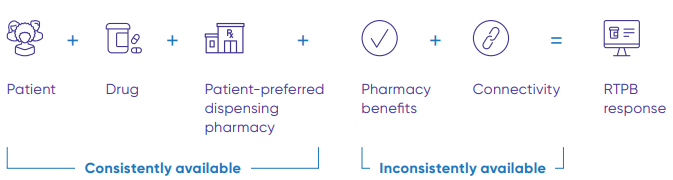
Among health systems Brown has consulted with, he has seen 25 to 40 percent of patient encounters fail to benefit from RTPB because of missing pharmacy benefits information in the EHR’s patient records. In these cases, initiating an RTPB query required pharmacy benefits eligibility information in a patient’s EHR record to be identified and verified. “Without verified pharmacy benefits eligibility data, the provider’s ability to use the network’s RTPB or ePA for these encounters is really limited,” he explains.
Even among patients who do have identified and verified pharmacy benefits, Brown has observed RTPB data inconsistencies for about 35 percent of encounters due to the second major cause of data gaps and another key component of an RTPB network: connectivity with the prescription benefit data source. RTPB networks vary in their handling of prescription benefit queries when they are not connected to the PBM as the data source. The network may not provide an RTPB response for these PBMs whatsoever, or they may provide an estimate from a pricing projection algorithm instead. When using algorithm-based projections, the benefit information the provider sees in the EHR can vary from what patients are told at the pharmacy.
Beyond the responses that are affected when the RTPB network is not connected to the PBM as the data source, there can also be issues even when it is connected to the patient’s PBM. Health systems may struggle with the quality of the information because of how PBM data is interpreted and displayed in the EHR. Brown describes how it can be “like a game of telephone,” adding “there are enough handoffs between the EHR to the network to the PBM and back that it is easy for data and messages to get slightly askew.”
Why RTPB network data gaps can go undetected
The extent to which data gaps due to pharmacy benefits eligibility and connectivity affect patient encounters is obscured. Martina Maki, Vice President of Product Development, explains, “EHRs designed RTPB to pop-up a prescriber notification when there is a threshold RTPB response to act on, such as a PA requirement, a drug exceeding a cost threshold, or if there are alternatives for consideration.”
Many of the routine RTPB responses – for low-cost generic medications, for example – are not designed to stand out and are intentionally left to the background where providers can seek out the information if they choose. As a result, the provider experiences these routine responses the same way the provider experiences nonresponses due to data gaps – in the background without attention being called to them by design. The provider interprets the two results where the pop-up does not appear the same way, even though the reasons for the pop-up not appearing are very different. “One system behavior is fine and working as expected, and one is not fine,” describes Maki.
Once providers and health systems find cost and coverage information is lacking or inaccurate for their patients, it can lead frustrated providers to give up on RTPB. “Providers very quickly lose faith in things that don’t work consistently,” says Brown. “If they can’t trust that the data is reliably available and accurate for their patient, RTPB becomes just another feature to ignore in their EHR.”
As health systems become aware of the inconsistent experience their providers are having with RTPB, many struggle with understanding the steps they need to take to get the cost and coverage transparency they were promised. Health systems often do not prioritize addressing their data gap issues because they are not aware of their options, nor the effort it would take to address data gap issues. Schaefer explains, “A lot of groups have simply given up on RTPB. They may think that all networks are the same and a 50 to 60 percent success rate is the industry experience. So there’s nothing that can improve the situation.”
In fact, Schaefer says, “All RTPB networks are not the same. Some have more data gaps than others.” The extent of RTPB data gaps can depend on the pharmacy benefits eligibility information in the patient’s medical record, the PBMs that comprise the RTPB network, and how those connections are configured. Schaefer continues, “You can’t just add an RTPB network on an EHR and expect it to be well integrated. Designing an RTPB network that works correctly is not trivial.” Maki adds, “An RTPB network needs to correctly interpret the data conveyed from each participant in the network as well as sufficiently understand each participant’s system design so that the intended meaning of the information is being conveyed between endpoints.”
Health systems hoping to reduce RTPB data gaps in an implemented network — or to implement an RTPB network with minimal data gaps to begin with — should examine the patient data in their EHR, as well as the RTPB network’s connectivity to benefit data sources. For example, how might the accuracy of their patients’ prescription benefits information limit the number the RTPB queries that could be run? Or if the health system already has an RTPB network in place, how are the number and configuration of PBM connections impacting the data quality of the RTPB queries? Factors that influence both eligibility and connectivity can be complex and difficult to navigate.
When it comes to choosing an RTPB provider, health systems need to ask the right questions to guide an implementation that minimizes data gaps in a new or existing network. Schaefer notes, “Partnering with an expert who can facilitate that process is usually the key to success.”
Cencora Benefit eServices helps health systems implement an RTPB network that can deliver on the promise of patient-specific cost and benefit transparency — with minimal health system effort.
Cencora Benefit eServices experts featured in this report
Matt Schaefer, President
Jason Brown, Vice President of Business Development
Martina Maki, Vice President of Product Development
Jason Reed, Licensed Pharmacist, Director of Product Development

References
- EHR Intelligence. COVID-19 Triggers Increase in ePrescribing, Interoperability Tools. 20 April 2021. Accessed 21 May 2021. Available online at: https://ehrintelligence.com/news/covid-19-triggers-increase-in-eprescribinginteroperability-tools
- Healthcare Dive. Cost major influence in choosing medical care, survey shows. 28 February 2019. Accessed 21 May 2021. Available online at: https://www.healthcaredive.com/news/cost-major-influence-in-choosing-medical-caresurvey-shows/549403/
- IQVIA. Medicine Spending and Affordability in the United States: Understanding Patients’ Costs for Medicines. 4 August 2020. Accessed 21 May 2021. Available online at: https://www.iqvia.com/insights/the-iqvia-institute/reports/ medicine-spending-and-affordability-in-the-us
- IQVIA. Medicine Use and Spending in the U.S.: A Review of 2018 and Outlook to 2023. 9 May 2019. Accessed 21 May 2021. Available online at: https://www.iqvia.com/insights/the-iqvia-institute/reports/medicine-use-and-spendingin-the-us-a-review-of-2018-and-outlook-to-2023
- American Medical Association. 2020 AMA Prior Authorization (PA) Physician Survey. 1 April 2021. Accessed 21 May 2021. Available online at: https://www.ama-assn.org/system/files/2021-04/prior-authorization-survey.pdf
- Centers for Disease Control and Prevention. Attitudes, Beliefs, and Cost-Related Medication Nonadherence Among Adults Aged 65 or Older With Chronic Diseases. 6 December 2018. Accessed 21 May 2021. Available online at: https://www.cdc.gov/pcd/issues/2018/18_0190.htm
- Patient Preference and Adherence. Medication Adherence as a Predictor of 30-Day Hospital Readmissions. 20 April 2017. Accessed 21 May 2021. Available online at: https://www.ncbi.nlm.nih.gov/pmc/articles/PMC5404806/