Artikkel
The growing case for AI to support pharmacovigilance: World Drug Safety Congress Americas key takeaways
-

Stephen Sun
-

Lin Li
Artificial intelligence and automation were top of mind at this year’s World Safety Congress. Held in Boston from November 4-6, the conference explored various themes and methods for navigating pharmacovigilance across the product life cycle.

While AI was broadly discussed in the main sessions, the breakout sessions focused on more esoteric safety-specific use of the technology.
During a busy workshop on the first day held by Jazz Pharmaceuticals, the presenters spoke briefly about potential use cases for AI before sharing a survey for questions and feedback from the audience. One question was about use of AI for literature screening. A small minority (9%) have fully AI-enabled capabilities, 29% are using it extensively with human involvement, 25% are using it a bit, and 36% are still exploring AI. Similarly, only 7% are using AI extensively to summarize or analyze safety cases, compared with 22% using it moderately, 36% exploring its use, and 34% not using it at all.
The findings and the discussion in general typify takeaways from the conference, with indications that sponsors are each on their own AI journey to determine how best to implement it in support of PV activities.
In our experience, how companies choose to implement and pilot AI largely depends on their size. Larger companies indicate that they will use in-house capabilities while smaller companies will depend on outsourcing partners.
During a busy workshop on the first day held by Jazz Pharmaceuticals, the presenters spoke briefly about potential use cases for AI before sharing a survey for questions and feedback from the audience. One question was about use of AI for literature screening. A small minority (9%) have fully AI-enabled capabilities, 29% are using it extensively with human involvement, 25% are using it a bit, and 36% are still exploring AI. Similarly, only 7% are using AI extensively to summarize or analyze safety cases, compared with 22% using it moderately, 36% exploring its use, and 34% not using it at all.
The findings and the discussion in general typify takeaways from the conference, with indications that sponsors are each on their own AI journey to determine how best to implement it in support of PV activities.
In our experience, how companies choose to implement and pilot AI largely depends on their size. Larger companies indicate that they will use in-house capabilities while smaller companies will depend on outsourcing partners.
However, presenters point out that sponsors generally will need vendor assistance since their focus and expertise is on manufacturing and commercializing medicines. One challenge is that providers will need integration into companies’ PV workflow to support AI.
The discussions also indicated that no major U.S. sponsor or vendor are doing end-to-end seamless PV at this stage, although several did mention pilots. One important consideration raised was the importance of simplifying and standardizing safety data and workflows before fully adopting AI.
Use cases for AI and automation
While AI tends to get the most attention, solutions typically blend AI and automation. Several discussions explored the importance of automation as a foundational tool for delivering audit-friendly, compliant workflows, ensuring organizations can manage regulatory scrutiny effectively.
There was extensive discussion on leveraging AI to automate the transcription, validation, and structuring of Individual Case Safety Reports (ICSRs). This approach helps organizations manage growing case volumes and complexity more efficiently.
Automation is also being used to better reconcile discrepancies between clinical trial databases and safety systems, particularly for serious adverse events, reducing errors and improving accuracy.
Sessions demonstrated how AI can draft and refine safety documents—such as Periodic Benefit-Risk Evaluation Reports, risk management plans, and narratives—more efficiently. This not only reduces the time spent on writing but also improves consistency and quality across deliverables.
Although discussions looked at some advancements for using AI for literature surveillance and aggregate report writing, these technologies are so far quite basic and skepticism about their use remains, particularly with report writing.
There was extensive discussion on leveraging AI to automate the transcription, validation, and structuring of Individual Case Safety Reports (ICSRs). This approach helps organizations manage growing case volumes and complexity more efficiently.
Automation is also being used to better reconcile discrepancies between clinical trial databases and safety systems, particularly for serious adverse events, reducing errors and improving accuracy.
Sessions demonstrated how AI can draft and refine safety documents—such as Periodic Benefit-Risk Evaluation Reports, risk management plans, and narratives—more efficiently. This not only reduces the time spent on writing but also improves consistency and quality across deliverables.
Although discussions looked at some advancements for using AI for literature surveillance and aggregate report writing, these technologies are so far quite basic and skepticism about their use remains, particularly with report writing.

The human factor in AI
Another takeaway is a strong focus on human-in-the-loop involvement, showing an understanding of AI or automation’s potential to improve efficiency, but not as a replacement for decision-making.
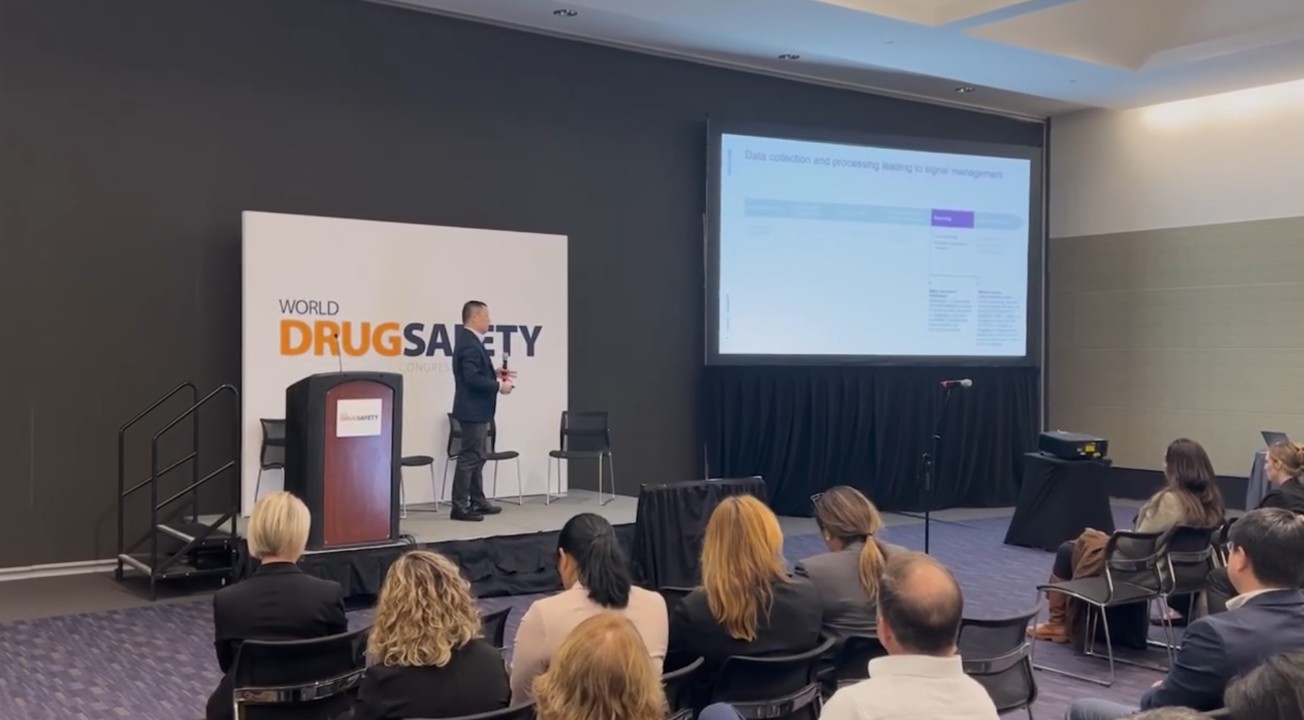
This is perhaps best exemplified with signal management, where AI or automation has huge potential when used with advanced analytics to streamline data harmonization, improve the accuracy of predictions, and accelerate decision-making. This was the subject of our presentation at the conference, entitled “Harnessing AI and advanced analytics to revolutionize pharmacovigilance signal management.” The benefits of AI with signal detection are to reduce the workload from managing signal validation and evaluation.
It was also clear from discussions at the conference that industry teams need to be upskilled and made better aware of AI’s potential for it to be successfully implemented and used. Company leaders can play a key role here by building awareness, mindfulness, and curiosity.
This is perhaps best exemplified with signal management, where AI or automation has huge potential when used with advanced analytics to streamline data harmonization, improve the accuracy of predictions, and accelerate decision-making. This was the subject of our presentation at the conference, entitled “Harnessing AI and advanced analytics to revolutionize pharmacovigilance signal management.” The benefits of AI with signal detection are to reduce the workload from managing signal validation and evaluation.
It was also clear from discussions at the conference that industry teams need to be upskilled and made better aware of AI’s potential for it to be successfully implemented and used. Company leaders can play a key role here by building awareness, mindfulness, and curiosity.
Exploring policy and RWD potential
While the US Food and Drug Administration (FDA) and the European Medicines Agency (EMA) were not at the meeting, several other authorities did attend, including Health Canada, the UK’s Medicines and Healthcare products Regulatory Agency (MHRA), and Uppsala Monitoring Centre (UMC), which serves as a World Health Organization collaboration center.
Although there were no major health authority updates forthcoming at the meeting, discussions emphasized the importance of aligning any AI solutions with regulatory expectations and ensuring inspection-readiness, validation processes, and establishing robust guardrails to ensure compliance. One other exciting area discussed during the conference was the use of real-world data for PV, particularly with regard to signal management. There is growing emphasis on how RWD is harnessed to detect signals sooner and more accurately. This will require the data to be properly analyzed, which again raises the case for advanced analytics.
Although there were no major health authority updates forthcoming at the meeting, discussions emphasized the importance of aligning any AI solutions with regulatory expectations and ensuring inspection-readiness, validation processes, and establishing robust guardrails to ensure compliance. One other exciting area discussed during the conference was the use of real-world data for PV, particularly with regard to signal management. There is growing emphasis on how RWD is harnessed to detect signals sooner and more accurately. This will require the data to be properly analyzed, which again raises the case for advanced analytics.
Conclusion: AI in the spotlight
The 2025 World Drug Safety Congress Americas shone a light on the potential to use AI and automation to support PV. And as a heavily operational field, pharmacovigilance presents a strong case for leveraging automation to improve efficiency. At the same time, the field is just beginning to learn, understand, and implement tools into workflows.
As the industry continues to pilot AI solutions, upskilling teams and fostering collaboration between sponsors, vendors, and regulators will be essential for realizing the full benefits of these transformative technologies.
As the industry continues to pilot AI solutions, upskilling teams and fostering collaboration between sponsors, vendors, and regulators will be essential for realizing the full benefits of these transformative technologies.
About the authors:
Stephen Sun, M.D., MPH, is Head of Pharmacovigilance and the Practice Area Lead for Benefit-Risk Management for Cencora. He has worked in generics, branded, and OTC products as a sponsor overseeing clinical, medical affairs, and drug safety. He has also served as a medical officer in risk management and controlled substances at the US FDA and is now supporting clients on the vendor side to support drug and biologic manufacturers in end-to-end PV systems.
Lin Li, Ph.D., is Head of Clinical Statistics and Computational Biology at Cencora. He provides data-driven and tailored solutions that integrate biostatistics, bioinformatics, computer science, and biology to tackle challenges in discovery and clinical development.
Devendrakumar Patel, R.Ph, M.Pharm, is Director, Customer Success Management Cencora. He brings over 14 years of expertise in pharmacovigilance and medical information, specializing in compliance strategies, safety surveillance systems, and inspection readiness. With a strong pharmacy background and hands-on operational experience in both industry and vendor environments, he has managed global safety operations, negotiated service-level agreements, and guided successful regulatory audits.
Lin Li, Ph.D., is Head of Clinical Statistics and Computational Biology at Cencora. He provides data-driven and tailored solutions that integrate biostatistics, bioinformatics, computer science, and biology to tackle challenges in discovery and clinical development.
Devendrakumar Patel, R.Ph, M.Pharm, is Director, Customer Success Management Cencora. He brings over 14 years of expertise in pharmacovigilance and medical information, specializing in compliance strategies, safety surveillance systems, and inspection readiness. With a strong pharmacy background and hands-on operational experience in both industry and vendor environments, he has managed global safety operations, negotiated service-level agreements, and guided successful regulatory audits.
Disclaimer:
The information provided in this article does not constitute legal advice. Cencora, Inc., strongly encourages readers to review available information related to the topics discussed and to rely on their own experience and expertise in making decisions related thereto.
Ta kontakt med teamet vårt
Vårt team av ledende verdieksperter arbeider iherdig med å omsette bevis, policy-innsikt og markedsinformasjon til effektive tilgangsstrategier for det globale markedet. Vi hjelper deg med å finne frem i dagens komplekse helsetjenester. Kontakt oss, så hjelper vi deg med å nå målene dine.